
Always a favorite among offshore anglers, wahoo are definitely crowd pleasers thanks in part to their sustained high-speed runs when hooked as well as their beauty, not to mention excellent table fare. Wahoo are built for speed, with a long, slender body tapering to an extremely pointed snout at the front end and near-vertical high-speed tail section at the opposite. Usually iridescent silver to blue in color, wahoo will often sport distinctive vertical blue stripes, although not always, and beware, that mouth is full of small but razor-sharp teeth. A favorite wahoo tactic: attack a baitfish at high speed, cutting off its tail to immobilize it before circling back to consume the remainder. They feed almost constantly in order to sustain that kind of high-speed, low-drag lifestyle, and therefore also grow rapidly. Fortunately, they are abundant and not considered overfished in North America. The IGFA All-Tackle World Record is 184 pounds, set in 2005 by Sara Hayward while fishing with her family on a charter boat out of Cabo San Lucas, Mexico; large wahoo exceeding 100 pounds are caught with frequency in the southern Bahamas during the winter months, but excellent fishing can be found from the canyons of the Northeast to the Florida Keys and Gulf of Mexico, and in the Pacific especially from southern California to Baja Mexico and beyond.
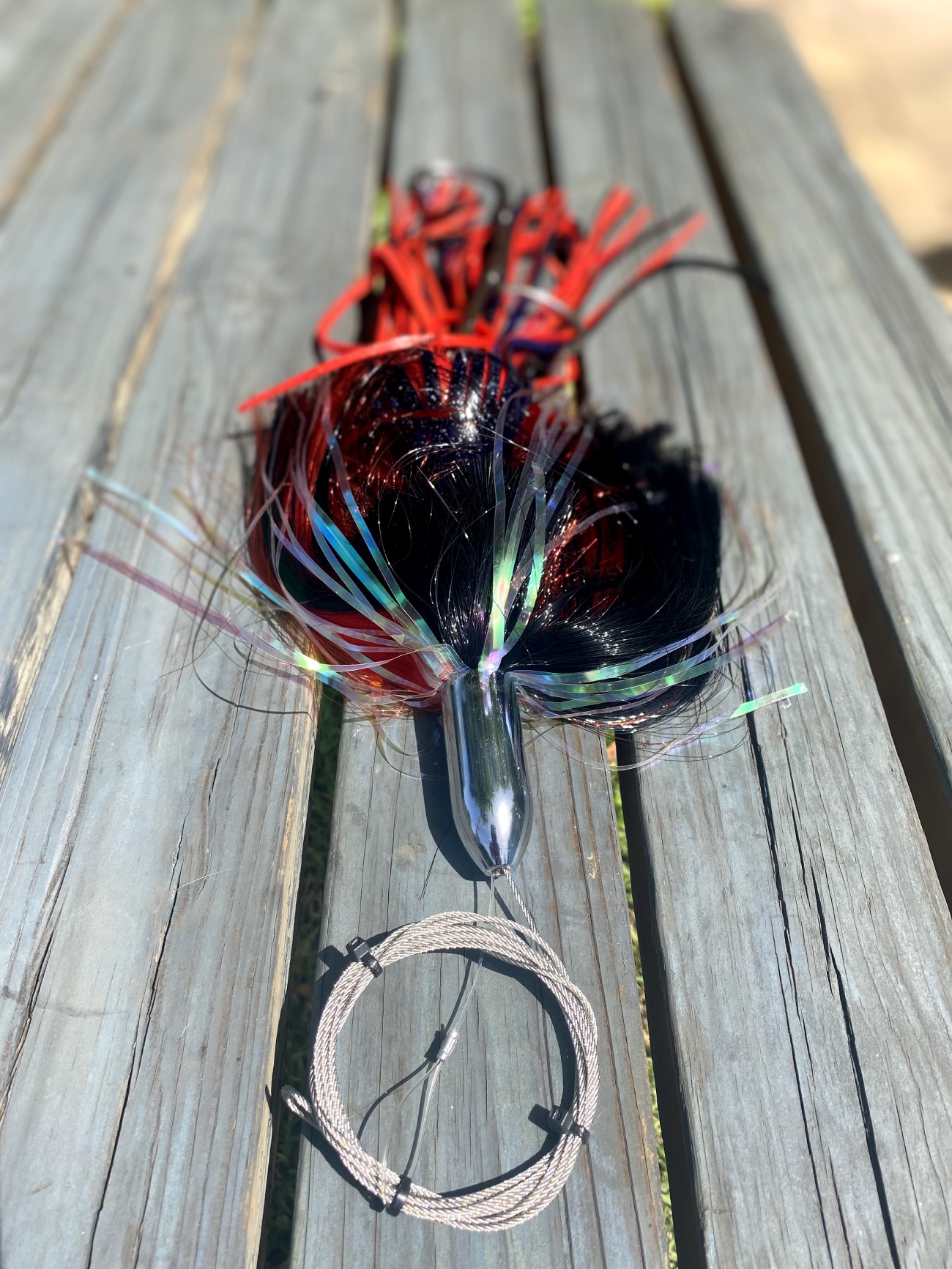
By contrast to the high-speed scenarios, a standard trolling spread deployed at a more sedate 7 to 10 knots will still produce plenty of wahoo bites while also remaining attractive to everything else from mahi to tuna to billfish. Just tailor one or two spots for wahoo to increase their attractiveness. For example, replace one of the flat lines with a heavier rod using a planer with a short wire leader and ballyhoo-and-Ilander combination so that it swims much deeper than the rest. Or use a large, lipped swimming plug like those produced by Nomad or Halco to produce the same effect, offering up a deep-swimming opportunity. Add a trolling lead ahead of one of the outrigger baits or send one far back behind the spread on the center rigger—the illusion of a straggler struggling to catch up with the school is often irresistible to big wahoo.
LIVEN UP
Live-baiting is a third technique, and perhaps the most productive of all. Begin with a livewell full of the largest and friskiest baits available; just about anything will produce bites but top picks are large blue runners, goggle-eyes, bullet tuna, small bonito, Spanish mackerel and others. It’s imperative to rig these on wire leaders, as a wahoo’s slashing strikes and sharp teeth will usually make short work of even the heaviest monofilament. Many anglers prefer treble hooks for the same reasons, with a single hook in the nose of the bait and a trailing treble pinned lightly to the back third of the bait in order to fool any short-strikers. Location is of key importance when live-baiting for wahoo though, as the slow trolling speeds of just a knot or two mean you won’t be covering much ground—target fish on ledges, rock piles, wrecks and artificial or natural reefs. And if a bait gets hit but the fish isn’t hooked immediately, put that outfit in freespool and allow the remaining pieces to fall naturally through the water column; often, the fish will circle and return to consume the rest, resulting in a solid hookup.
SAFETY FIRST
When gaffing a wahoo, it’s best to aim for the point where the body joins the head in order to control them as they come over the gunwale. Always be aware of the fish’s jaws and teeth—bare feet or sandals have no place on deck when bringing one aboard, as many anglers have learned. Even small wahoo should be deposited quickly into a waiting fishbox and not allowed to thrash around, possibly injuring a crewmember.