MAINTAIN NATURAL CHARACTERISTICS
When crafting bedding areas for deer, arguably the most important thing I try to keep in mind is maintaining the characteristics of the land where the deer are naturally choosing to bed without any habitat improvements.
As I scout a natural deer bed, some of the questions I ask myself include: How much side cover surrounds the bed and how far can the deer see? What type of wind conditions would make the most sense for a deer to bed here? How close is the deer bed to a primary food source?
Answering questions like this allows me to paint a picture in my head of what an ideal bedding area looks like.
SIZE MATTERS
The perfect size for a bedding area isn’t a one-size-fits-all answer. When focusing on doe groups I tend to make them a little larger to accommodate for more deer. My sweet spot for doe bedding is right around the 0.25-acre mark. Buck beds on the other hand are much smaller and are often developed in very specific locations which I will cover later in the article.
OPEN CANOPY
An open canopy allows sufficient sunlight to reach the forest floor, promoting the growth of native grasses and other vegetation preferred by deer. This new growth creates thick cover which allows the deer to feel secure and the more secure a deer feels on your property, the more time they will spend on it.
HORIZONTAL COVER
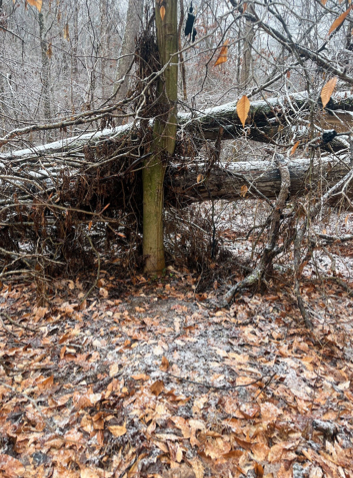
Horizontal cover is equally important within the interior and along the exterior of bedding areas. Felled trees, hinge cutting, and brush piles are all examples of different ways you can provide cover at eye level to hide deer.
There is an art to selecting what trees to drop fully and which ones to hinge cut as well as what order to do so. A general rule of thumb that I like to follow is to remove up to 80% of the canopy within a targeted bedding area. I will drop the larger trees first to create a foundation and finish things off with the more detailed and delicate hinge cutting.
MULTIPLE ENTRY/EXIT ROUTES
Not to be overlooked, providing the deer with multiple ways in and out of bedding areas will increase the likelihood they will be used more frequently. Providing multiple routes will make it so the deer never feel trapped inside the bedding area.
When creating these entry and exit routes I always like to keep in mind the full layout of the property. I will often connect the routes with travel corridors leading to destinations such as a food plot to provide the deer with an easy path of travel directly to a highly desired location.
FINDING THE RIGHT LOCATION FOR DEER BEDDING AREAS
Just like the details of how to create a bedding area can vary, so can the exact location of the bedding area. What are some things to consider when drawing up the perfect bedding location?
A great place to start is to consider whether you are trying to create a group of doe beds or a single buck bed. Not only will the size and the design look different, but so will the location.
DOE BEDDING AREAS
On a property with properly managed hunting pressure, doe families will tend to bed in the first available cover next to primary food sources. Does are far less picky when it comes to choosing bedding than a buck, especially mature bucks.
The main reason for this is because doe families can rely on the safety of numbers to always have an advantage. Picture a group of 6-8 all bedded in the thick stuff next to a food source. Each deer can bed in a slightly different direction to maintain a 360-degree visual of the surrounding area.
Oftentimes one of the best ways for me to tell if I have come across doe bedding while scouting is by observing a group of beds all facing different directions in a relatively tight section.
When it comes to picking out the best locations for doe bedding on a property, I will typically try to choose the most suitable areas near the primary food sources.