
As gamekeepers, we have a close connection to the land and wildlife. When we hunt, fish, work the soil and manage habitat we’re often on lands that connect us to the past where the original gamekeepers (Native Americans) did much the same. Native Americans revere Mother Earth, as the giver of all things necessary for life. Throughout history their cultures left historic evidence of their existence across the country in the form of artifacts such as arrowheads, tools, and pottery. From a hunter’s perspective, finding an arrowhead is awe-inspiring – to actually hold a weapon used by an ancient archer.
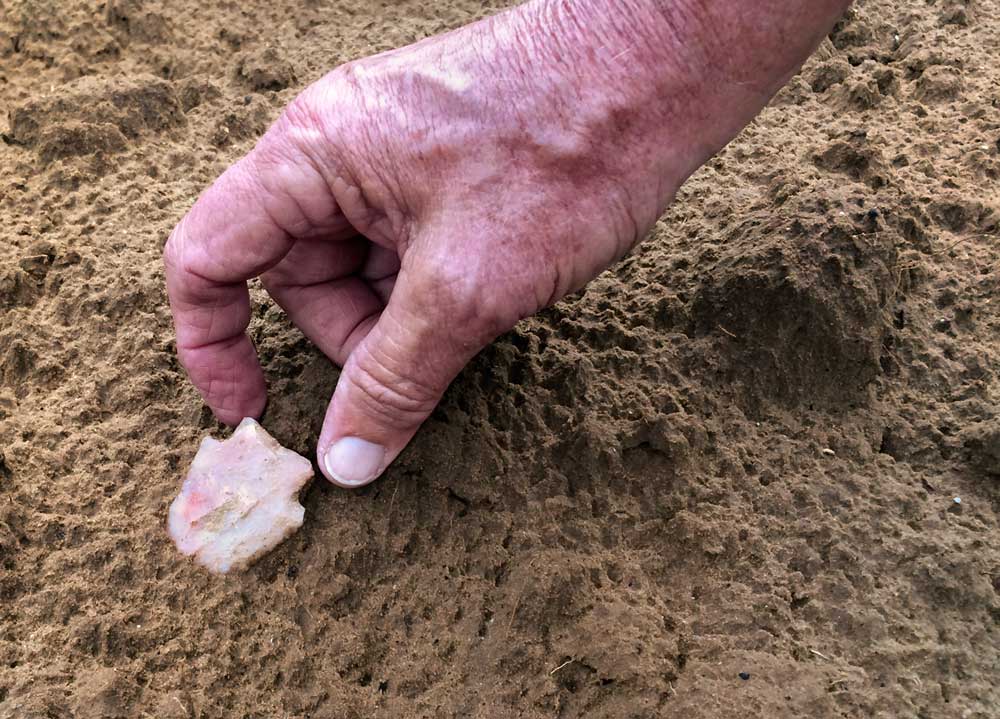
Recently, while scouting a game trail crossing a wide firebreak, this bowhunter spied the unmistakable flaked edges of a stone arrowhead. The point jutted from the soil alongside a fresh deer track, as if aimed for the animal that stepped over it.
In a whisper of thanks while reaching for the relic, a realization set in – these were the final seconds of a millenniums-old passage of time, ending with its discovery and my strong yearning to have met the arrowhead’s maker. The sharpened stone represented a tangible connection, if not spiritual kinship, with a fellow hunter from long ago. It had laid embedded in the trail’s soil, trod upon by generations of hunters and game. Finally, on that day, our paths crossed and the hand-crafted weapon was plucked from the earth and held once again in a hunter’s hand.
The point’s finely worked edges revealed the maker’s creativity and craftsmanship. Out of necessity and need, he’d chosen the stone, chipped with practiced pressure, and gave it a life of function and purpose. My imagination conjured up questions and images of what the man might have looked like. What was he wearing while chipping away at the stone, transforming it into the business end of a weapon? What tribe did the maker belong to? How old is the arrowhead? What type of stone is it? Was it shot at an animal or used in warfare? Was it a hit or a miss? Perhaps it was lost here. Whatever, this was a lucky day. Driven by a tendency towards superstition, (what bowhunter isn’t?) the weapon, now turned lucky charm, took on a new purpose and slipped easily into a pocket alongside my hunting knife.
WHERE TO LOOK FOR ARROWHEADS AND ARTIFACTS
Early Native Americans were nomadic hunter/gatherers before later settling into a more agrarian culture. Artifacts are found in every state throughout North America, particularly near water sources. Water sustains life. It’s necessary for drinking but it also provided primitive cultures with food, transportation and hunting opportunities for animals coming to water. Native Americans established permanent settlements near water sources. Seasonal hunting and trading camps were also typically situated near some type of water source.
Think of the earth’s soil as flowing, similar to how rainwater flows towards rivers, constantly being moved by natural and manmade forces. Prehistoric Indian village sites may now be buried up to several feet below the ground’s surface due to silt deposits from repeated flooding and erosion. Over thousands of years, rivers and streams change courses. Lake levels rise and fall. As weather and natural conditions change, the water flow and channels, silt and soil also flows and forms terraces at the outer edges of the flood plain as waters recede. These rich soil areas above the flood plain were ideal locations for villages.
Today, as modern wildlife, timber and farming practices occur in these areas, rains expose artifacts after the soil is disturbed. Crop fields, wildlife food plots, firebreaks and power-line right of ways where soil is regularly disturbed are good locations to surface hunt for artifacts. Other places to consider are construction sites and areas where erosion occurs naturally, such as drainage ditches, gravel bars where feeder creeks empty into a main river channel, in cut banks along rivers and creeks and small feeder creeks leading to larger bodies of water.
A variety of items are typically found in village sites. These include waste rock, flakes, burned rocks, pottery and stone tools such as scrapers and drills. Arrowheads are also found, but many may be damaged or broken during chipping. Others are unfinished or rejects. Arrow-heads lost during a hunt could be anywhere. It’s a good reason to always be on the lookout when afield. Those found in an isolated setting such as a mountain ridge top or in the gravel of a creek bed are often whole and in perfect condition.
Walking a creek for artifacts is a great summertime family activity. The cool, wet environment provides pleasant conditions for searching gravel bars and cut banks. Some of everything in a watershed (think village sites) gets deposited in the gravel of gullies and creeks. However, not all creeks will contain artifacts. Rapid erosion typically occurs near head waters. Larger artifacts and fossils will be located there. Smaller ones will be swept downstream with rocks of similar size and weight. These settle on sand and gravel bars in quiet flow areas of the drainage. Creek finds may produce artifacts from widely different cultures and time periods.